

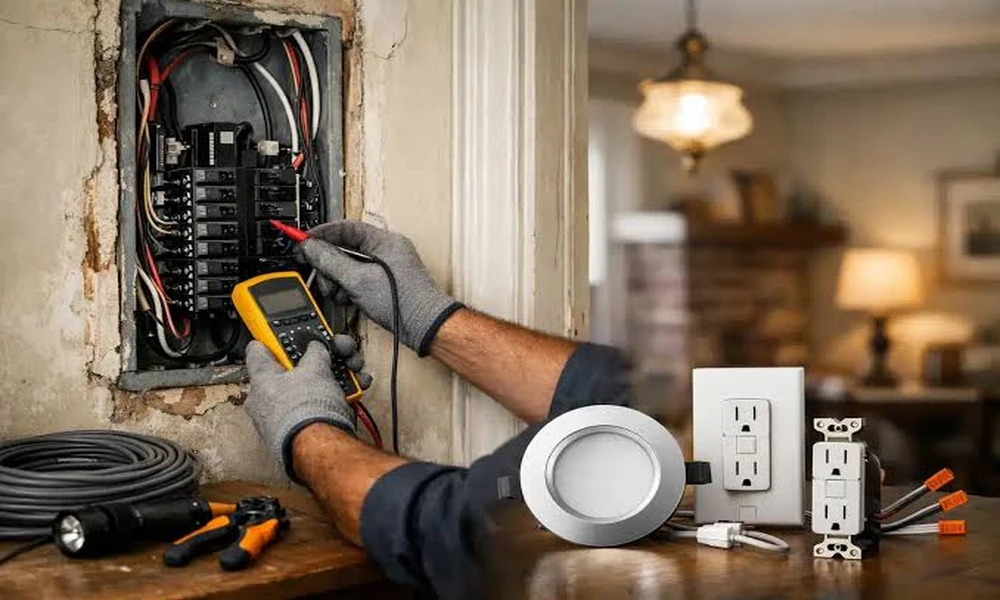
Walk through almost any Fairfax County neighborhood built between the 1960s and the 1990s and the houses look much as they did on move in day. Inside the walls, though, a lot has changed. Garages now hold electric cars, home offices run all day, and gas furnaces are giving way to heat pumps. Each of those shifts puts new demands on wiring that was designed for a very different household.
Plenty of homeowners first notice the gap during a small project. They call an electrician in Fairfax to add an outlet or swap a fixture, and the conversation turns to a crowded panel, a missing surge device, or a garage that cannot support a charger without changes. Those moments tend to lead to the same handful of upgrades across the county.
Here are the six that come up most, along with what each one actually involves and a question worth asking before the work begins.
1. Level 2 EV Charging in the Garage
Electric vehicles have become a common sight in driveways from Reston to Springfield, and many owners outgrow the slow trickle of a standard 120 volt outlet within weeks. A Level 2 charger runs on 240 volts and usually needs a dedicated circuit somewhere between 40 and 60 amps, depending on the charger’s rating.
The county treats a new circuit for a charger as electrical work that needs a permit. According to Fairfax County’s EV charging station permit guidance, no permit is needed when a stand alone charger simply plugs into an existing outlet, but new circuits and outlets do require one. Residents of Vienna and Clifton also need approval from their town, and the county publishes separate guidance for homeowner associations.
Worth asking: Can the charger’s output be set lower to fit the panel, rather than upgrading the service right away?
2. Panel and Service Upgrades for an Electric Household
Many older Fairfax homes still run on a 100 or 150 amp service. That was plenty when the house had a gas furnace, a gas water heater, and a few kitchen appliances. Add a heat pump, an induction range, a heat pump water heater, and an EV, and the math changes quickly.
A load calculation tells the real story. It adds up what the home already uses and what the new equipment will draw, then shows whether the existing service can handle it. Sometimes the answer is a 200 amp upgrade, which involves the utility, the meter base, and a county inspection. Other times, a smart panel or load management device can share capacity between appliances that rarely run at full power together.
Worth asking: Does the plan account for every electric appliance you expect to add in the next five to ten years, not just the one on the schedule today?
3. Whole Home Surge Protection
Power strips protect only what is plugged into them. A whole home surge protective device sits at the main panel and helps shield everything downstream, from the HVAC control board to the refrigerator to the router. Northern Virginia’s summer thunderstorms and the surges that follow outages make this more than a theoretical concern.
The Electrical Safety Foundation International notes that the 2020 National Electrical Code made surge protection a requirement for home services, and its overview of home surge protective devices explains how they protect electronics and power quality. In practice, homes getting a new or replaced panel will typically get one installed as part of the job. Older panels can have one added on its own.
Worth asking: Does the device have a status light, and what does it look like when the unit has done its job and needs replacing?
4. Hardwired Networking for Home Offices
Fairfax County has one of the largest remote and hybrid workforces in the country, and video calls do not forgive a weak signal. Mesh Wi-Fi helps, but many households are adding hardwired Ethernet to the office, the living room media setup, and the spots where wireless access points live.
Running cable through finished walls in a split level or a colonial takes planning, especially when the network hub sits in a basement utility room. Grouping network runs with other electrical work, like new outlets or lighting, saves opening walls twice.
Worth asking: Will the cable be rated for future speeds so it does not need replacing in a few years?
5. Lighting That Matches How Rooms Are Used Now
Recessed LED lights have replaced many of the dome fixtures and track lights that came with older homes. The fixtures themselves are simple, but problems often show up afterward as flicker, buzzing, or dimmers that cut out at low settings. Most of that traces back to dimmers that are not compatible with LED loads.
Good lighting work also looks at layout. Basements turned into gyms, dining rooms turned into offices, and kitchens with new islands all need light in different places than the original plan provided.
Worth asking: Are the dimmers listed as compatible with the specific LED fixtures being installed?
6. Safe Backup Power for Storm Season
The region has seen enough derechos, ice storms, and long summer outages that backup power is no longer a niche request. Portable generators are common, and so are the risks that come with running extension cords through a window or plugging a generator into a wall outlet.
A properly installed inlet box paired with an interlock kit or transfer switch lets a generator feed selected circuits without sending power back onto utility lines, which can endanger line workers. Larger homes may opt for a standby generator with an automatic transfer switch.
Worth asking: Which circuits truly need to stay powered during an outage, and can the setup prioritize those?
Bundling the Work Pays Off
Several of these upgrades touch the same panel, the same walls, and the same permit process. Planning them together often means one service upgrade instead of two, fewer holes in finished drywall, and a single round of inspections. Even when the budget only covers one project this year, a clear long range plan keeps today’s work from blocking tomorrow’s. In older Fairfax homes, that kind of foresight is often what separates a smooth upgrade from a frustrating one.
