

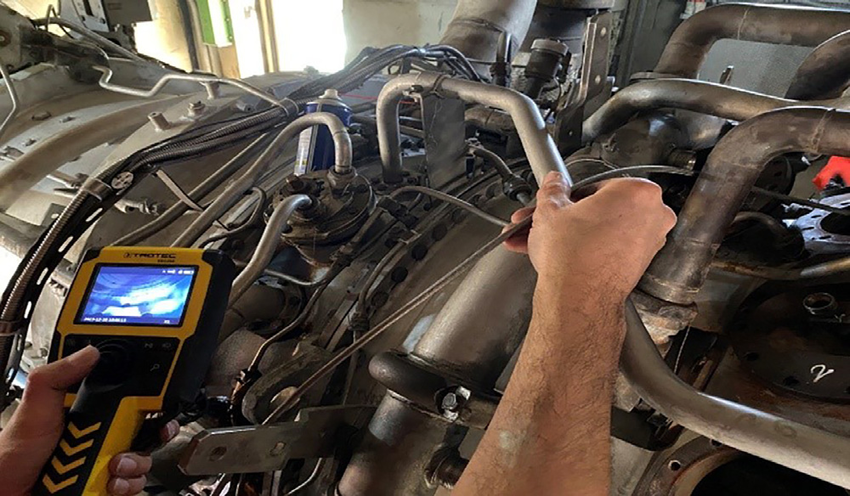
As a preventative approach, borescope checks find problems before they become failures. These inspections are essential parts of an overall quality assurance plan. Especially for companies that are committed to maintaining the highest levels of operational safety and product integrity.
Examining a turbine’s interior parts without dismantling it is a non-destructive method. It visually checks important regions for wear, corrosion, or damage using this device.
It has a camera as well as a light at its tip. The borescope inspection enables personnel to diagnose any issues and evaluate the turbine’s condition. They can schedule maintenance to avoid malfunctions and expensive downtime.
Borescope Types
- Rigid
These cannot bend; they are straight. They work best when examining regions that are directly visible to you. Their primary advantage is that they provide extremely clear pictures.
These are excellent for identifying microscopic flaws or other issues. They are not useful for examining twisted regions, though, because they are unable to bend to view around corners.
- Flexible
These are also known as fiberscopes. To illuminate obscure or dark places, they employ fiber optics. Their adaptability helps examine intricate or curved areas.
They are useful in various sectors, including aerospace. Since they can reach locations that other types cannot, even if they don’t provide as crisp pictures as rigid ones.
- Video
The characteristics of both rigid as well as flexible kinds are combined here. They may display video of excellent quality or still pictures on a screen. They feature a camera (CCD / CMOS) on the flexible shaft.
These pictures can also be saved for later. Many of these instruments are equipped with additional functionality. Such as the ability to measure faults, adjust light levels, or even do 3D imaging.
- Semi-Rigid
These are a combination of flexible and stiff. During examination, they can slightly flex while maintaining their form. This is helpful when you want clean photos yet still require some bending capabilities.
Check out https://en.wikipedia.org/wiki/Borescope for added info.
How Does It Work?
- Tool
A flexible and rigid optical instrument that has a light source and a high-resolution camera.
- Insertion
An access port, like an ignitor port, is used to enter the borescope into the turbine.
- Inspection
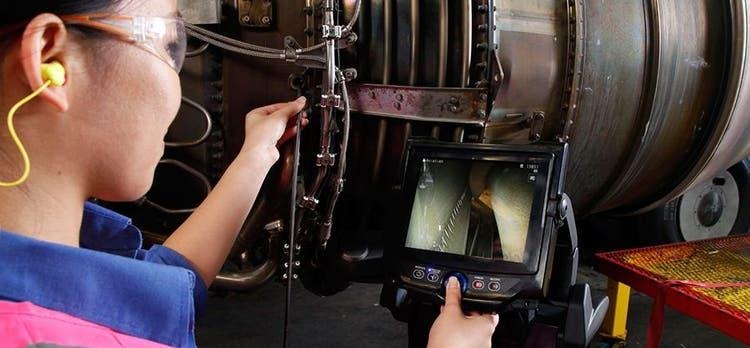
The technician uses this instrument to examine interior parts such as stators, combustion chambers, and turbine blades. The camera transmits real-time photos or video to a display while the light source brightens the dimly lit interior.
- Analysis
To find problems like fractures, coking, corrosion, or foreign item debris, the technician can take high-quality pictures. To make sure that parts are working within safe bounds, they can also assess wear.
Applications in the Gas & Oil Industry
- Pipeline Inspections
These are essential for moving gas and oil. Their interior state has to be routinely checked for flaws like corrosion and fractures.
Borescopes save time and lower the possibility of pipeline damage. By enabling inspectors to confirm the cleanliness and condition of the pipeline core without requiring major disassembly.
- Engine and Turbine Inspections
In the oil and gas sector, engines as well as turbines are essential parts. They are frequently found in production facilities and drilling rigs.
Maintaining operating efficiency requires inspecting these parts without disassembling them. To ensure that these machines run safely and efficiently. Borescopes allow inside components to be inspected for corrosion, wear, and damage. Click this website to learn more.
The Process
Setting the goal is the first step in starting a borescope examination. What specific internal components are required to be assessed, and what possible problems should be looked for? The following actions are conducted when the goal has been established:
- Equipment Preparation
The right kind is selected in accordance with the inspection specifications. And the apparatus is set up, including any necessary camera calibration and adjustments.
- Accessing the Area
To access an entrance point into the component, it may be necessary to remove coverings or panels. And make use of pre-existing apertures like inspection ports or spark plug holes.
- Navigation as well as Maneuvering
The camera is inserted and moved through the structure with caution. This entails bending as well as rotating the scope to guarantee a thorough view of the region.
- Visual Examination
The inspector closely examines the pictures as the camera transmits them back to the display. Looking for any anomalies such as corrosion, cracks, misalignments, or abrasions.
- Documentation
All significant discoveries are recorded. High-resolution photos or video recordings can be taken using video borescopes for further investigation.
- Analysis of Findings
To assess the seriousness of any problems found and identify the required remedial measures, the gathered data is examined.
- Reporting
A thorough report is produced, frequently with visual proof. Decisions for maintenance are based on this.
Importance
- Prevents Damage
It makes it possible to identify problems early. If ignored, it might result in serious malfunctions and hazardous circumstances.
- Minimizes Downtime
Early problem detection aids in maintenance planning. This lessens the need for expensive repairs and unscheduled shutdowns.
- Cost Savings
It eliminates the substantial effort and expenses related to a complete disassembly for periodic checks.
- Verifies Maintenance
This may be utilized to visually verify that repairs were completed correctly. They make sure that no tools or dirt are left behind.
